
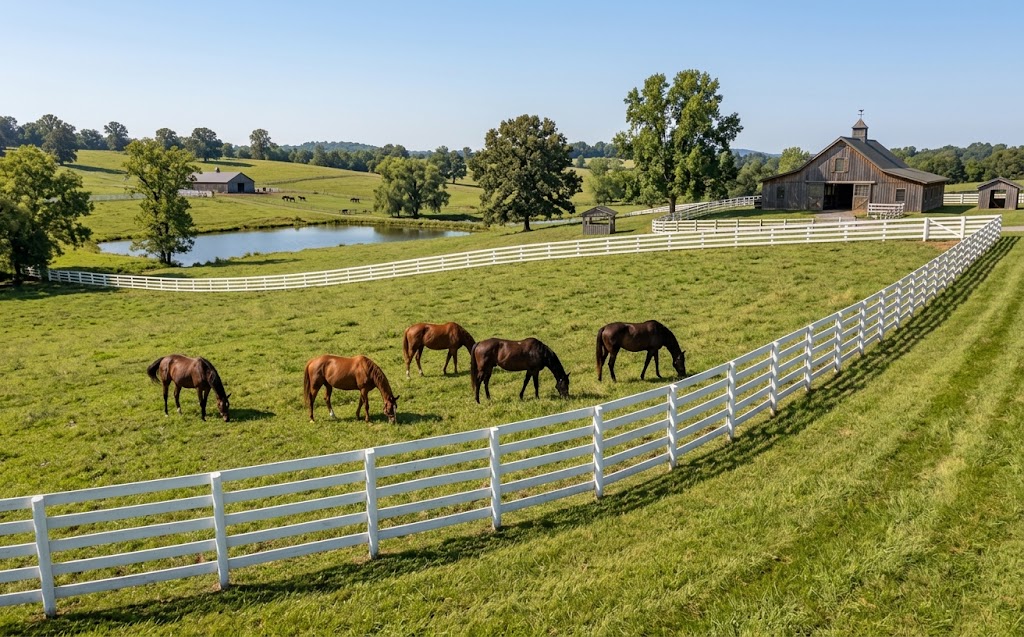
Once you’ve got a handle on how much acreage your horses actually need, there are three things I walk every farm buyer through before we write an offer: the fencing, the water, and the zoning. None of them show up clearly in listing photos, and all three can turn a dream property into an expensive headache if you don’t check them early. (If you’re just getting started, my guide to buying a horse farm in Central Kentucky covers the bigger picture.)
Fencing: Not All Fence Is Created Equal
Fence height and visibility are the two biggest safety factors for horses. According to University of Illinois equine extension guidance, perimeter fencing should be a minimum of 5 feet tall for most light breeds, and 6 feet for taller breeds or when foals are involved. Visibility matters just as much as height — horses that can’t clearly see a fence are more likely to run into it, which is part of why wire fencing (hard to see, and prone to causing cutting injuries on collision) tends to rank lower on safety compared to board, mesh, or high-visibility electric options.
When you’re touring a farm, don’t just count the board fence out front — walk the perimeter and interior cross-fencing too. Ask:
- Is the fencing sound and horse-rated, or does it need replacing?
- Are there sections of wire, barbed wire, or old field fence that would need to come out before you could safely turn horses out?
- Is the fencing already divided for rotational grazing, or is that cross-fencing you’d be adding yourself?
Fence replacement isn’t cheap, so factor it into your offer if what’s there doesn’t meet a safe standard. Fencing also matters when you sell someday, since it’s one of the things buyers and appraisers look at. I explain more in what a Kentucky farm is really worth.
Water: Who Actually Owns It
Kentucky follows the riparian rights doctrine, which means if a property borders a stream, creek, or lake, the landowner generally has the right to make reasonable use of that water — but “reasonable” is doing some legal lifting there, and it doesn’t guarantee water quality or year-round flow. If the farm relies on a well instead, know that Kentucky’s Division of Water regulates well drilling and certifies well drillers, but it doesn’t guarantee groundwater quality — that’s on you to test.
One detail that surprises a lot of buyers: if you’re purchasing 10 or more acres for agricultural use, Kentucky’s Agriculture Water Quality Act requires a written water quality plan for the property. Worth asking your agent (that’s me) whether the current owner already has one on file, since it can save you a step after closing.
Practically speaking, walk every pasture and ask where the horses actually drink. A creek that looks great in July can run dry by September, and hauling water to a back field gets old fast — something I touched on when we talked about what a horse actually needs in terms of land.
Zoning: It’s Different in Every County
This is the one people assume is uniform across Kentucky, and it isn’t. Zoning for horses and agricultural use is set county by county, and the differences matter:
- In Lexington-Fayette County, keeping horses on residential-zoned property requires…a minimum of 3 acres for the first horse, plus 1 additional acre for each horse after that — and boarding or riding lessons for others isn’t permitted under that exception.
- In Woodford County (home to Versailles), “agricultural use” classification under state law (KRS 100.111) requires at least 5 contiguous acres.
- Some counties tie an agricultural tax exemption to a 10-acre minimum, separate from the zoning question entirely.
The upshot: don’t assume a property’s acreage automatically qualifies it for agricultural zoning, a horse-keeping exception, or a farm tax rate. Each county’s planning and zoning office can confirm exactly what a specific parcel is entitled to — and I always recommend we check before you fall in love with a property that can’t legally do what you’re planning to do with it.
Bring the Right Questions to Every Showing
Between fencing, water, and zoning, none of these are dealbreakers on their own — but they’re all fixable-or-not-fixable-in-your-budget kinds of questions, and it’s much better to ask them at showing #1 than at the inspection. If you’ve already found a property you love, I’m happy to help you dig into all three before you write an offer — give me a call at (502) 639-9223.
More farm guides: Central Kentucky Farm & Horse Property